How to Source Construction Chemicals Within Budget Without Sacrificing Quality

A construction chemical bought at the lowest rate can still become the most expensive item on site. Failed waterproofing, delayed grouting, poor bonding, or rejected material can push labour, rework, and schedule costs far beyond the original saving.
The better approach is to treat construction chemicals as performance-critical materials, not simple consumables. Waterproofing compounds, admixtures, tile adhesives, sealants, repair mortars, curing compounds, anchors, and grouts all affect durability. Buying them within budget requires a clear specification, reliable supplier checks, careful price comparison, and firm quality controls.
A disciplined approach to Construction Chemicals Prices and Sourcing helps project teams control cost without weakening the structure, delaying work, or inviting hidden expenses later.

Start with the specification before asking for rates
Price comparison only works when suppliers quote for the same requirement. A vague enquiry such as “waterproofing chemical required” invites mismatched products, unclear coverage, and wide rate differences.
Start with a written specification that defines what the material must do.
Include:
Application area
Basement, terrace, bathroom, water tank, podium, façade joint, tile area, repair zone, or industrial floor.
Substrate condition
Concrete, masonry, plaster, blockwork, screed, metal, or old coating.
Performance requirement
Water resistance, bonding strength, flexibility, crack bridging, chemical resistance, shrinkage control, curing support, or rapid setting.
Application method
Brush, roller, trowel, spray, injection, mixing with mortar, or batching plant dosing.
Coverage expectation
The quoted coverage should match the surface condition and the required number of coats.
Site constraints
Monsoon exposure, high humidity, fast handover, live site work, storage limits, or restricted access.
Approval requirement
Brand approval, consultant approval, test certificate, material data sheet, or method statement.
This reduces confusion and gives every supplier the same base. It also prevents a common budget trap: approving a cheaper product that needs more coats, more primer, higher consumption, or skilled labour that was not included in the first quote.
Build a supplier shortlist that goes beyond low prices
Reliable sourcing starts with supplier screening. A strong supplier should not only quote a good rate, but also deliver the right product, on time, with documentation and technical support.
Check authorisation and product traceability
Ask whether the supplier is an authorised distributor, stockist, applicator partner, or reseller. This matters because construction chemicals are sensitive to shelf life, storage, and product authenticity.
Request:
GST-compliant invoice
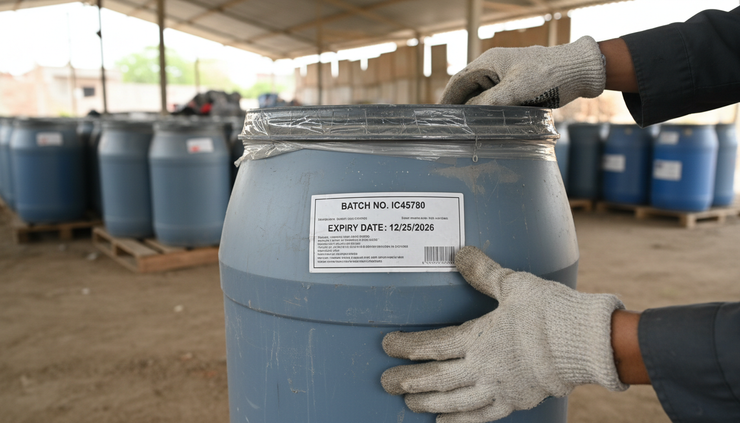
Batch number details
Manufacturing date and expiry date
Product data sheet
Safety data sheet
Test certificates where applicable
Warranty terms, if offered
Written confirmation of storage conditions
Avoid suppliers that cannot clearly explain where the material comes from. Low-cost material with weak traceability can create problems during consultant inspections, client audits, or defect liability claims.
Review delivery capacity
A supplier may offer the lowest rate for the first lot and then struggle to supply repeat quantities. This can stop work midway, especially in waterproofing, tile fixing, grouting, and concrete admixture operations.
Before finalising, ask:
Current stock available
Lead time for repeat orders
Minimum order quantity
Delivery charges
Emergency supply support
Availability during holidays or peak season
Ability to supply the same batch or compatible batches
For large projects, consistency matters. A mid-project brand or grade change may need fresh approval and trial application, which can cost both time and money.
Assess technical support
Good construction chemical suppliers help solve application issues before they become failures. For complex systems, technical support can be as valuable as a small discount.
Look for suppliers that can provide:
Site inspection before product recommendation
Method statement
Consumption calculation
Surface preparation guidance
Applicator training
Mock-up or sample application
Support during first application
Troubleshooting for curing, debonding, cracks, or leakage
This is especially important for waterproofing systems, injection grouting, industrial flooring, concrete repair, and high-performance admixtures.
Compare the full landed cost, not only the basic rate
The basic rate per kg, litre, bag, or drum is only one part of the cost. A cheaper quote can lose value once freight, taxes, wastage, coverage, primers, accessories, and labour are included.
Create a comparison sheet with the full landed cost. Keep it simple but complete.
Cost item | What to check | Why it matters |
Basic material rate | Rate per kg, litre, bag, or kit | Helps compare quotes on a common unit |
GST | Tax rate and invoice type | Affects billing and input credit planning |
Freight | Included or charged separately | Remote sites can see large cost changes |
Loading and unloading | Included or by site team | Hidden labour cost often gets missed |
Coverage | Practical site coverage, not ideal lab coverage | Poor surfaces increase consumption |
Primer or additives | Required as part of the system | Low rates can hide system costs |
Wastage | Shelf life, pot life, mixing loss, spillage | Impacts total quantity required |
Storage | Covered space, temperature control, stacking | Poor storage can damage material |
Testing and approvals | Any sample, mock-up, or third-party testing | Adds cost before full use |
Rework risk | Probability of failure or rejection | The largest hidden cost in poor buying |
For example, a waterproofing coating may look affordable per kg. But if it needs a primer, two coats, protection screed, corner treatment, mesh, skilled applicators, and strict curing time, the true installed cost is different from the invoice price.
The best comparison is often cost per completed square metre, cost per cubic metre of treated concrete, or cost per running metre of joint, depending on the product category. This gives a practical view of what the material will cost once installed.
Understand how margins affect project budgets
Margins sit at every level of construction chemical supply. Manufacturers, carrying and forwarding agents, distributors, dealers, applicators, contractors, and project vendors may each add a margin. That is normal. The issue is not the presence of margin, but lack of visibility.
A project can lose budget control when multiple margins are added without clarity on who is responsible for stock, warranty, delivery, application, and after-sales support.
Where margins usually enter the chain
Margins may appear in:
Dealer markup on material
Contractor markup on supply
Applicator margin on supply and labour
Transport handling cost
Credit period adjustment
Small-lot premium
Urgent delivery premium
Brand substitution margin
Site storage and wastage allowance
If the contractor supplies and applies the chemical, the material rate may include more than product cost. It may cover logistics, applicator risk, tools, supervision, and warranty responsibility. That can be fair, as long as the quote states what is included.
If the project buys directly and gives the material to an applicator, the material rate may drop. Yet the project then carries responsibility for correct product selection, storage, quantity planning, and compatibility. Any failure can lead to arguments between supplier and applicator.
Hidden expenses that reduce apparent savings
Small hidden costs can quietly damage the budget.
Common examples include:
Extra coats due to rough plaster or honeycombed concrete
Higher consumption on porous surfaces
Expired material disposal
Rejected material due to missing documents
Delay because the approved brand is unavailable
Colour or batch variation in visible sealants or flooring
Separate primer or bonding agent not included in the quote
Labour idle time during delayed delivery
Rework after wrong mixing ratio or poor curing
Warranty gaps when products are mixed across brands
A low-margin direct purchase can work well for experienced teams. For complex systems, paying for a supplier or applicator with technical responsibility may reduce total risk.
Negotiate prices without weakening the specification
Price negotiation should protect value, not push the supplier into cutting corners. The goal is to reduce avoidable cost while keeping the approved product, coverage, warranty, and support intact.
Use volume and schedule clarity
Suppliers can quote better when they know the likely volume and delivery schedule. Instead of asking for one urgent rate, share a planned consumption schedule.
For example:
Monthly admixture requirement for concrete production
Terrace waterproofing area broken into phases
Tile adhesive requirement by tower or floor
Sealant quantity by façade stage
Repair mortar requirement by structural repair zone
This helps suppliers plan stock and reduce emergency logistics. It also gives room for slab-based pricing.
Ask for a system quote
Many failures happen when buyers pick one cheap item from one brand and another accessory from a different source. For waterproofing, flooring, repair, and anchoring, ask for a complete system quote.
A system quote should mention:
Product name and grade
Primer, mesh, joint band, bonding agent, or topcoat
Surface preparation requirement
Consumption per coat or layer
Application method
Warranty scope
Exclusions
Technical support included
This makes negotiation more honest. It also reduces the risk of buying material that performs poorly because the supporting products were missed.
Compare approved alternatives carefully
Consultants or clients may approve equivalent brands if the product meets the specification. In Indian projects, shortlists often include large brands and category leaders, and online searches may surface terms such as #fosroc #Dr.fixit #Sika during early market checks.
Do not compare brands only by reputation or rate. Compare the exact grade, performance values, application limits, and system requirements. A premium brand may have an economical product in one category, while a regional manufacturer may offer good value in another. The right choice depends on fit for purpose.
Negotiate commercial terms as well as rate
If the supplier cannot reduce the material rate, there may still be room to improve the commercial package.
Ask for:
Free delivery above a defined order value
Better payment terms
Rate validity for a fixed period
Batch reservation for phased supply
Technical visit included
Sample and mock-up support
Replacement for damaged or expired stock caused by supplier delay
Clear return policy for unopened material, where practical
These terms can protect the budget better than a small rate cut.

Maintain quality while staying within budget
Quality control does not need to be expensive. It needs discipline. Most construction chemical problems start with poor selection, wrong storage, weak surface preparation, or rushed application.
Control approvals before bulk purchase
Do not buy bulk quantities before technical approval. First submit the product data sheet, method statement, test certificates, and sample where required. If the consultant asks for a mock-up, complete it before placing the full order.
This avoids blocked stock and forced usage of unsuitable material.
Calculate quantity with site conditions in mind
Theoretical coverage assumes a clean, sound, uniform surface. Indian construction sites often have uneven plaster, dusty slabs, honeycombing, moisture, laitance, or surface cracks. These conditions increase consumption.
Add a reasonable wastage allowance based on the product type and site condition. Avoid excessive buffer stock for short shelf-life products such as certain grouts, anchors, and two-component systems.
Store materials correctly
Construction chemicals can lose performance when exposed to heat, moisture, sunlight, or contamination. Storage control is a low-cost way to protect quality.
Good site practice includes:
Keep bags and drums off the ground
Store cementitious products in dry areas
Protect liquid products from direct sunlight
Follow temperature limits mentioned by the manufacturer
Use older stock first
Do not open packs until needed
Keep hardeners, resins, and powders matched as supplied
Mark rejected or damaged material clearly
Poor storage can turn a correct purchase into dead stock.
Train the applicators
Even premium products fail when mixed or applied incorrectly. For two-component coatings, grouts, anchors, sealants, repair mortars, and tile adhesives, mixing ratio and pot life are critical.
A short toolbox session before application can prevent costly errors. Cover:
Surface cleaning
Moisture condition
Mixing time
Water addition limits
Pot life
Coat thickness
Waiting time between coats
Curing and protection
Safety precautions
Ask the supplier’s technical representative to attend the first application for critical areas. This support can save far more than it costs.
Inspect during application, not after failure
Final inspection is too late for many chemical applications. Check quality while work is happening.
For waterproofing, verify surface preparation, corner treatment, coat thickness, curing, and protection before covering it with screed or tiles.
For admixtures, monitor dosage, compatibility, slump behaviour, setting time, and concrete finish.
For tile adhesives and grouts, check bed thickness, open time, joint cleaning, and curing.
For sealants, check joint width, backing rod, primer need, depth-to-width ratio, and tooling quality.
Simple checklists help keep quality consistent across floors, towers, or zones.
Finalise the purchase with clear terms
Once the supplier and product are selected, the purchase order should remove ambiguity. A clear purchase order protects both cost and quality.
Include:
Exact product name, grade, and pack size
Approved brand or equivalent approval note
Quantity and unit
Rate and tax details
Delivery location and schedule
Freight and unloading responsibility
Required documents
Shelf-life condition at delivery
Batch details, if needed
Storage and handling instructions
Return or replacement terms
Warranty or performance support, if applicable
For critical applications, attach the approved method statement to the order or work order. This connects the commercial purchase with the technical requirement.
Avoid verbal substitutions. If a supplier proposes an alternative due to stock issues, get written approval from the consultant, client, or authorised project engineer before accepting delivery.

A practical sourcing checklist for budget control
Use this checklist before finalising construction chemicals:
Confirm the application area and performance requirement.
Prepare a clear specification before requesting prices.
Ask all suppliers to quote on the same basis.
Compare installed cost, not just pack rate.
Check batch number, manufacturing date, and expiry date.
Confirm whether primer, mesh, additives, or tools are needed.
Review freight, unloading, GST, and credit terms.
Verify supplier authorisation and stock availability.
Get technical documents before approval.
Conduct a mock-up for critical systems.
Train applicators before large-scale work.
Inspect surface preparation and application stages.
Keep records of delivery, usage, and balance stock.
Avoid unapproved product changes during execution.
The best budget decision is the one that survives the site
Sourcing construction chemicals within budget is not about choosing the lowest quote. It is about controlling the full cost of performance. The right supplier, correct product, transparent margins, clear purchase terms, and disciplined site application can keep the budget intact without reducing quality.
Treat every chemical purchase as part of the finished work. If it protects concrete, stops water, bonds tiles, seals joints, repairs defects, or changes concrete behaviour, it deserves proper review before the order is placed.
A well-finalised purchase should answer three questions clearly: what is being bought, why it is suitable, and what it will really cost once applied on site. When those answers are clear, budget control and quality can work together.

Comments